

Palo Alto’s Horizontal Levee pilot project, located on a 500-foot-long section of coastline on Harbor Marsh in the Palo Alto Baylands is under construction and set to inform other Bay Area projects advancing sea level rise protections and improving marsh habitat in the San Francisco Bay.
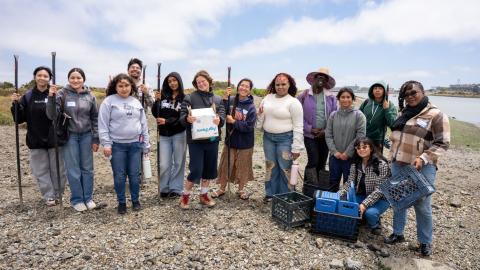
A tour of the construction site with the project team took place last week, while 35 volunteers participated in community planting, adding native plants on the levee.
“This project is the first of its kind to be built on the San Francisco Bay shoreline, utilizing treated wastewater from the Palo Alto Regional Water Quality Control Plant to irrigate native plants and restore a transition zone between freshwater and salt marshes,” said Karin North, Palo Alto’s assistant director of public works, the department that owns and operates the Regional Water Quality Control Plant. “As the sixth largest plant in the Bay Area, we are thrilled to be piloting this innovative nature-based solution to sea level rise that will also benefit the marsh habitat by reusing treated wastewater.”
The Regional Water Quality Control Plant treats 20 million gallons of sewage per day from 236,000 residents and businesses in its service area and is owned and operated by the City of Palo Alto. Located on 25 acres near the Baylands Nature Preserve, the Plant serves as a regional plant for six partner agencies (East Palo Alto Sanitary District, Los Altos, Los Altos Hills, Mountain View, Palo Alto, and Stanford University).
Construction advancing the $4.8 million project began in September. Last Wednesday, the San Francisco Estuary Partnership/Association of Bay Area Governments along with the City of Palo Alto, hosted a tour for media to gain a behind the scenes look at the project. Simultaneously, Save The Bay hosted its first community event to plant the levee's native habitats. Over the next few weeks, Save The Bay and their volunteers will be planting over 2,000 native plants representing 35 different species at the project site.
“This project seeks to address the question of how we protect our communities from sea level rise, do we want build a wall or do we want to advance these innovative projects that offers multiple benefits that include public access, increased habitat for species and addresses sea level rise,” said Caitlin Sweeney, director with San Francisco Estuary Partnership/Association of Bay Area Governments. “Research is a critical element in this project and helping to inform future large-scale projects of this kind throughout the Bay Area.”
The San Francisco Estuary Partnership/Association of Bay Area Governments and the City of Palo Alto are partnering with scientific researchers at United States Geological Survey (USGS), California State University Channel Islands, and University of California Davis to study the levee and understand how it changes over time, and what habitat benefits it may offer compared to a traditional levee. The project involves community education about nature-based solutions and engaging community scientists through partnerships with Nuestra Casa, Association of Ramaytush Ohlone, and Environmental Volunteers.
Project managers Heidi Nutters, principal program manager, San Francisco Estuary Partnership/Association of Bay Area Governments and Samantha Engelage, senior engineer, City of Palo Alto shared project details and offered a status update on the construction underway. Construction is about a third of the way complete with full completion estimated in summer 2026.
Learn about this project at https://www.sfestuary.org/pahlp/. Community members interested in future planting events, can sign-up at https://savesfbay.org/calendar/.


Submit your comment
In order to receive a reply to your comment, please provide an email address.